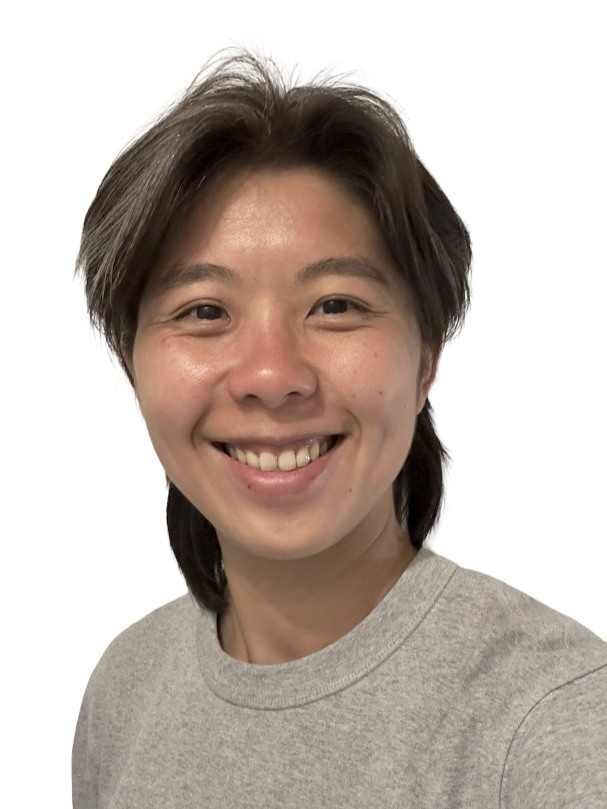
Sloane Kuo
I have spent a decade inside organisations as the person who could not stop asking what things were actually for.
I did not come from business or marketing. My background is sports and health science — scientific method, experimentation, and a lifelong habit of taking things apart to see how they work. So when I started out at NEXCOM designing visuals and tradeshow experiences, I worked the only way I knew: not "how do I hit the metric," but "what makes this product actually solve what it claims to?" To display something well, I had to reverse-engineer it — work backward from the specs to the person using it, sitting with the engineers until I understood why the problem it solved existed at all. I was told, more than once, that this was a waste of time.
I kept doing it anyway. It was the only thing I knew how to do.
At IAdea, I pointed the same instinct at people. Building go-to-market campaigns, I sat with the sales team and studied what each prospect actually needed to make a decision, then consolidated all of it into a tool the company had never built before. We were backordered. Every demo I had built sold off the floor — and the work that produced it, the talking-to-people part, was treated as a detour from real marketing.
At Wellell, the same instinct scaled. I was brought in to build a brand communication system, an internalisation programme, a marketing and sales foundation. Most people saw those as separate. I saw one system: the same underlying logic, distributed differently — each piece really a product with its own audience to design for. The organisation was thirty times the size of the last. The way of seeing did not change. Only the scale of what it was pointed at.
At CyberLink, I built the first comprehensive product-marketing operating procedures a thirty-year-old department had ever had — not a spreadsheet of tasks and deadlines, but purpose and instruction behind every step.
And somewhere across those years, I hit a wall I could not reverse-engineer my way through — the same wall, in more than one of these places. I won't say which; the people are real and the point is not the name. In one, I would do the honest work and people would meet me honestly, and it changed nothing, because the outcome was always quietly pre-decided — everyone performed a transparency they knew was theatre, and what happened on the ground never reached the room where direction was set. In another, there was nothing to optimise at all, because the structure was not running on process. It was running on fear.
These were not broken organisations I could fix. That was the thing I finally understood. They were working exactly as designed — and what they were designed to do, underneath everything measurable, was wear down the people inside them. I watched colleagues medicate to get through the workday. I did it too. Not because any of us were weak — because the structures we were in were doing something to us that no performance review, no engagement score, no org chart would ever name.
You cannot optimise your way out of a structure that is working as intended. You can only see it clearly, and name what it's doing.
That is why I built EcologyMap. After a decade of reverse-engineering everything I touched — products, then people, then whole systems — I turned the same faculty on its truest object: the gap between where an organisation believes it is heading and where it is actually taking the people inside it. Not to fix it from the inside. To read it. Because the structures that cost people the most are the ones that look like they are working — and someone has to point at the layer where the truth is hiding.
That is the work I do now.